

Planning a memorable company event in Central Europe often brings the challenge of mixing tradition and modern energy. Whether you are staging a Munich gala or hosting a Vienna product launch, the right blend of live music and DJ services can transform the atmosphere completely. Understanding audience expectations, event purpose, and technical needs lays the groundwork for seamless transitions between live bands and DJs, ensuring your event never loses momentum or engagement.
Table of Contents
- Step 1: Assess Event Requirements And Audience Needs
- Step 2: Coordinate Setlists And Transitions Between Band And DJ
- Step 3: Prepare Technical Setup For Seamless Integration
- Step 4: Rehearse Transitions And Timing For Live Performance
- Step 5: Monitor Audience Engagement And Adjust On The Day
Quick Summary
| Key Message | Explanation |
|---|---|
| 1. Understand event requirements | Define the purpose, audience size, and venue capabilities to tailor entertainment effectively. |
| 2. Coordinate transitions | Plan and rehearse transitions between the band and DJ to ensure seamless performance. |
| 3. Technical setup is crucial | Assess venue tech needs early to prevent issues with sound quality and performance. |
| 4. Keep audience engagement in mind | Designate an observer to monitor crowd reactions and adjust the performance accordingly. |
| 5. Documentation is essential | Create an event brief and timeline to guide performances and transitions smoothly. |
Step 1: Assess event requirements and audience needs
Before you book a DJ, a band, or both, you need to understand exactly what your event demands. This step shapes every decision that follows, from technical setup to performance style. Get this right, and your event flows seamlessly; skip it, and you’ll face surprises on the day.
Start by answering these core questions about your corporate event.
What is the event’s primary purpose? A product launch, annual gala, team-building day, or awards ceremony each demands a different atmosphere. A launch might need high-energy entertainment to create buzz, whilst a gala requires sophistication and refinement. Understanding the core purpose tells you whether you need a DJ to drive dancing, a band to provide cultural authenticity, or both working in harmony.
How many people will attend? A 50-person executive dinner requires a completely different approach than a 500-person conference. Smaller groups appreciate close interaction with musicians, whilst larger crowds need amplification, sight lines, and professional staging. Crowd size determines whether you can use an unplugged acoustic setup or need a fully amplified stage with DJ equipment.
What’s the venue layout and technical capacity? Visit the space beforehand. Measure it. Check for power outlets, stage area, ceiling height, and acoustic considerations. Some venues have excellent sound systems already installed; others need everything brought in. Understanding these constraints prevents equipment failures and ensures the band and DJ can perform properly.
Consider your audience’s musical expectations and cultural background.
Here’s a quick comparison of band and DJ suitability for different event scenarios:
| Event Type | Best for Bands | Best for DJs | Combined Approach Benefit |
|---|---|---|---|
| Product Launch | Live energy, culture | High-tempo atmosphere | Creates buzz and engagement |
| Gala Dinner | Sophisticated ambience | Polished background | Seamless style and refinement |
| Team-Building Session | Interactive moments | Flexible playlist | Keeps energy and involvement |
| Awards Ceremony | Focal performances | Smooth transitions | Maintains pace and excitement |
- Corporate demographic: Do your attendees enjoy traditional music, international hits, or Bavarian authenticity? Central European audiences often appreciate oompah music and polkas, whilst international groups may prefer party hits with traditional elements mixed in.
- Energy level preferences: Some corporate events call for background music that encourages conversation. Others need high-energy entertainment that gets people dancing and engaged.
- Language considerations: Will your audience appreciate traditional German songs, yodelling, and waltzes, or do they prefer English-language party tracks?
The better you understand your audience’s tastes and your venue’s capabilities, the more confidently you can blend live music and DJ services into a cohesive experience.
Document your findings in a simple event brief. Write down the date, time, expected attendance, venue details, atmosphere goals, and musical preferences. This becomes your reference point for every conversation with performers.
Pro tip: Ask your venue manager about any restrictions on amplified music, performance times, or stage setup before you commit to booking—surprises about noise limits or equipment access can derail careful planning.
Step 2: Coordinate setlists and transitions between band and DJ
Smooth transitions between your band and DJ are what separate forgettable events from unforgettable ones. Without coordination, you’ll face awkward silences, clashing musical styles, and confused guests. The secret lies in careful planning and clear communication between both performers.
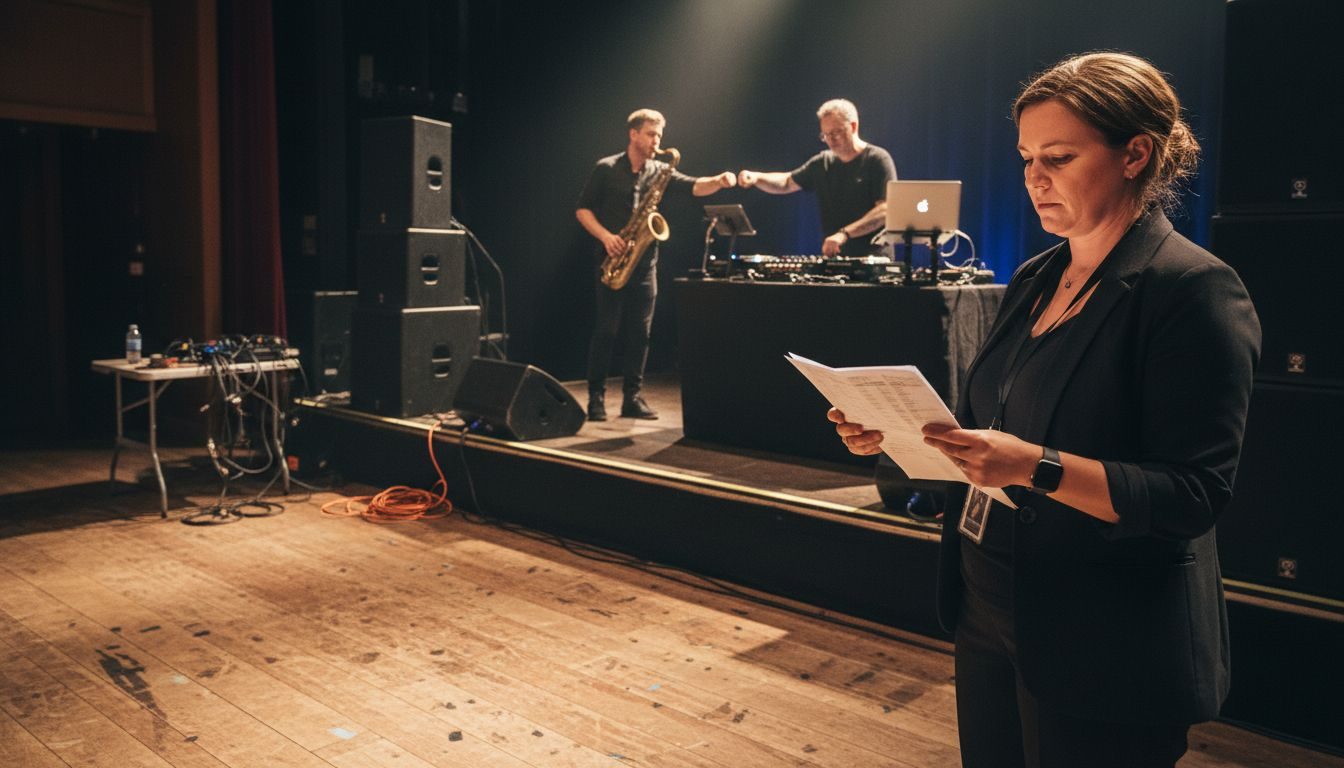
Start by having a detailed conversation with both your band and DJ well before the event. Share your vision for how the night should flow. Will the band perform first, setting a sophisticated tone, then the DJ takes over with higher energy? Or do you want them alternating throughout the evening? Understanding the performance dynamics between live bands and DJs helps you create transitions that feel natural rather than jarring.
Create a shared setlist document that maps out the entire event timeline. Include the band’s song selection with approximate timings and the DJ’s opening tracks. The band’s final song should connect musically to the DJ’s first track, creating momentum rather than stopping dead.
Key coordination points to address:
- Crossover songs: A shared tune where the band fades out whilst the DJ picks up creates seamless flow without dead air or awkward pauses.
- Lighting synchronisation: Coordinate with your lighting technician to change the atmosphere as the transition happens, reinforcing the energy shift.
- Audio mixing: Ensure both performers understand how to overlap sound or hand off cleanly without feedback or volume drops.
- Master of ceremonies role: Appoint a host to announce set changes, keeping your audience engaged during transitions.
Before the event day, have the band and DJ rehearse their handoff together if possible. At minimum, they should speak by phone or video call to walk through timing and technical details.
Overlapping audio mixes and synchronised lighting changes prevent those awkward gaps that kill momentum and leave guests wondering what happens next.
Assign clear technical responsibilities. Define who handles cueing, who watches timing, and who manages audio levels during transitions. Write these down so there’s no confusion when the energy is high and everyone’s focused on performance.
Pro tip: Create a printed timeline for the band, DJ, and your technical staff showing exact transition times and key songs, then do a brief soundcheck run-through of the handoff so everyone feels confident when it matters.
Step 3: Prepare technical setup for seamless integration
Technical preparation makes or breaks the combined band and DJ experience. Poor audio setup creates feedback, dropped signals, and frustrated performers. Proper planning ensures both acts sound professional and blend seamlessly together.
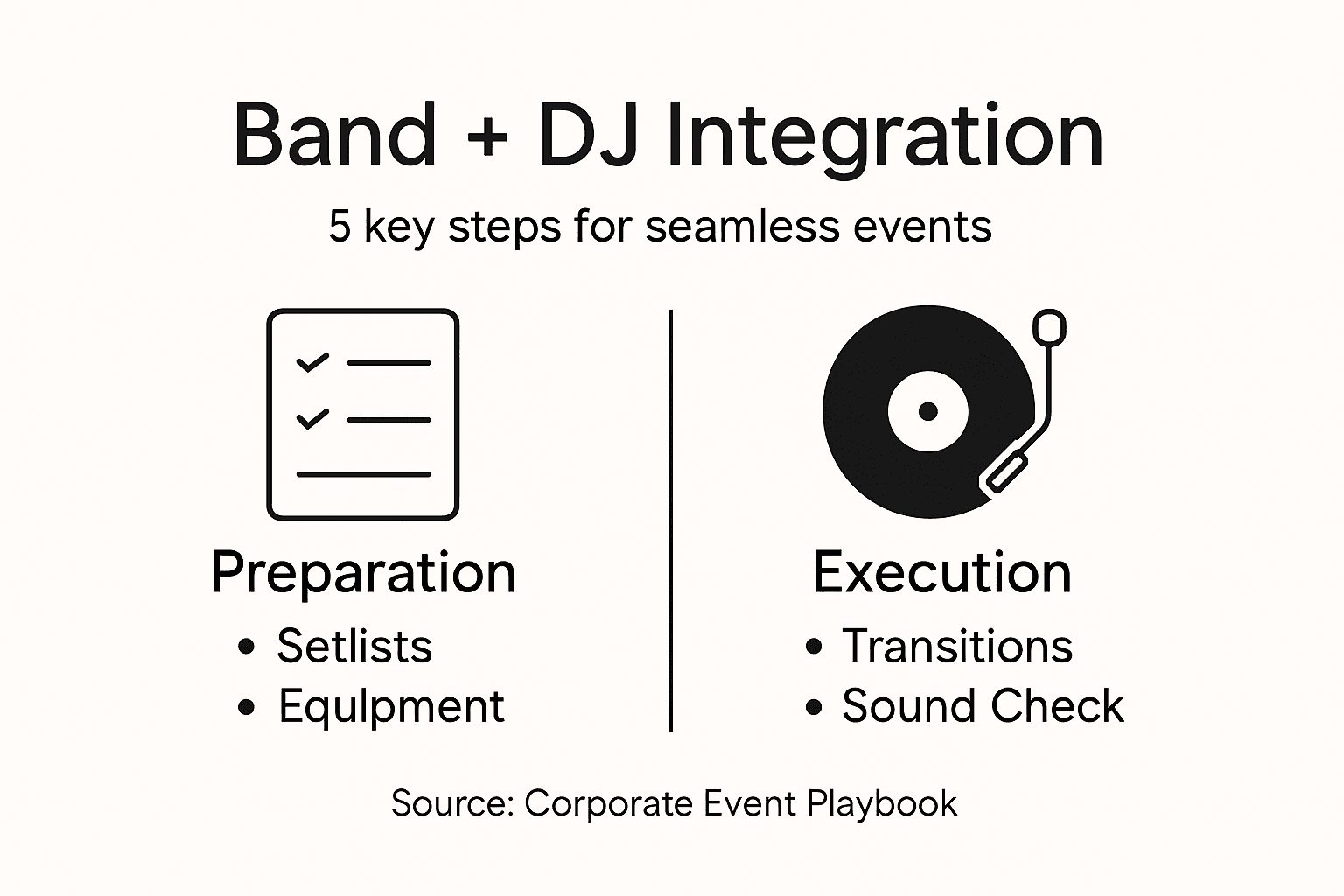
Begin by assessing your venue’s existing technical infrastructure. Visit the space and check what’s already installed—mixers, speakers, microphones, amplifiers. Understand the acoustics and size to determine what additional equipment you’ll need. A 100-person boardroom requires different gear than a 500-person ballroom.
Design an audio setup with separate channels for the band and DJ. This gives your technical operator mixing flexibility and prevents one performer’s audio from drowning out the other. Each act needs independent control without compromising overall sound quality. When designing audio systems for integrated live events, ensure the DJ controller integrates smoothly with your mixer and that all instruments feed into the same system.
Address these critical technical elements before event day.
- Cabling and connections: Plan cable runs from stage to mixer to speakers. Use high-quality, shielded cables to prevent noise. Label everything so setup and teardown happen quickly.
- Power distribution: Ensure sufficient outlets and backup power supplies for all equipment. Dead batteries mid-performance create disaster.
- Microphone placement: Position mics to capture the band’s sound without picking up unwanted noise or feedback from DJ speakers.
- Lighting synchronisation: Programme your lighting rig to respond to both live music and DJ cues without technical conflicts.
Conduct a full technical rehearsal before your event. Have the band play through their set whilst the DJ stands by with headphones. Test the transition where the band fades out and the DJ takes over. Identify problems now, not during your corporate event.
Thorough technical rehearsals help identify and resolve potential issues early, ensuring flawless sound quality when guests arrive.
Hire or assign experienced technical staff familiar with both live music equipment and DJ systems. They’ll handle real-time adjustments, troubleshoot problems, and keep everything running smoothly.
Here are typical technical roles for seamless live event integration:
| Responsibility | Band Technician | DJ Technician | Event Coordinator |
|---|---|---|---|
| Audio Setup | Instrument mics, mixing | Deck setup, levels | Oversees all elements |
| Lighting Coordination | Stage lighting cues | Mood lighting adjustments | Manages synchronisation |
| Transition Management | Cue hand-off song, timing | Fade in, cue tracks | Master timeline |
| Troubleshooting | Instrument issues | Equipment problems | Rapid team communication |
Pro tip: Create redundant backup systems for critical equipment like the main mixer and speakers, then brief your technical team on exactly how to switch to backups if something fails during the event.
Step 4: Rehearse transitions and timing for live performance
Rehearsal separates polished performances from chaotic ones. When your band and DJ practise together, they develop the timing and communication needed for flawless transitions. Skipping this step invites surprises on the night.
 Play videoBy starting the video you accept loading from YouTube (Google). See our privacy policy.
Schedule a dedicated joint rehearsal with both your band and DJ at least one week before the event. This isn’t a casual run-through—it’s focused practice with specific goals. Everyone needs to understand exactly when handoffs happen, how tempo changes occur, and what cues trigger each transition.
Start by reviewing your shared setlist together. Walk through the band’s final three songs and the DJ’s opening three tracks. Mark exactly where the band stops and the DJ begins. Identify any tempo mismatches or musical clashes that need adjusting. The band’s last song should lead smoothly into the DJ’s opener, not feel jarring.
Practise the actual transitions at performance tempo. Mastering transitions requires proper timing and phrasing to avoid clashes and maintain energy flow. Have the band play their closing sequence whilst the DJ listens and prepares to jump in. Run through this several times until both acts feel confident. Muscle memory develops through repetition.
Focus on these rehearsal elements:
- Mic hand-offs: If the band vocalist passes a microphone to an MC or the DJ, practise this smoothly. Dropped mics or feedback destroy the moment.
- Energy matching: The DJ should match or elevate the energy the band leaves off with, not drop it dramatically.
- Audio cues: Establish what you’ll actually hear—a count-down, a drum hit, a musical cue—to signal transitions.
- Backup plans: If something goes wrong, what happens? Practise recovery so performers stay calm.
Run through full performance sections, not just transitions in isolation. Developing muscle memory through consistent practice of timing and cues minimises surprises during live shows. Have your technical operator present to test audio switching and lighting changes.
Rehearsal reveals what works and what doesn’t, giving everyone confidence when the actual event begins.
Document everything. Create a written timeline showing exact songs, timings, and who does what. Distribute this to your band, DJ, technical staff, and any MCs involved.
Pro tip: Record your rehearsal on your phone, then watch it back together and discuss what felt smooth and what needs adjustment—this objective review often reveals timing issues the performers missed.
Step 5: Monitor audience engagement and adjust on the day
The best events adapt in real time. Your carefully planned setlist and transitions provide structure, but your audience’s energy tells the true story. Monitoring engagement during the performance allows you to make adjustments that keep guests invested and entertained.
Designate someone on your event team to watch the crowd throughout the performance. This person isn’t performing—they’re observing. Position them where they can see both the audience and the performers, ideally with a clear view of the dance floor or main gathering areas.
Look for observable signals of engagement. Are people dancing, standing engaged, or sitting quietly? Do they respond enthusiastically when the band plays certain songs? Does energy dip noticeably during specific tracks? Body language, crowd movement, and participation in interactive moments all reveal what’s working and what isn’t.
Use real-time audience engagement tools to gather more data if your event supports them. Live polls, interactive features, and social media activity provide quantifiable feedback beyond observation. These tools help identify moments when energy peaks or drops, allowing immediate adjustments.
Establish a simple communication system between your observer and the performers. This might be hand signals, text messages, or a brief conversation during breaks. Keep it unobtrusive—you don’t want guests noticing constant behind-the-scenes coordination.
Common adjustments you might make during an event include:
- Extending popular songs: If a track gets a huge response, have the DJ extend it or the band play an extra verse.
- Skipping underperforming songs: If a planned track isn’t resonating, skip it and move to something more energetic.
- Changing the setlist order: If your audience needs an energy boost earlier than planned, shuffle the sequence.
- Increasing interaction: Ask the band to encourage sing-alongs or get the DJ to invite guests to make requests.
Observable metrics like participation and body language help assess the vibe, enabling performers to adjust setlists and engagement tactics dynamically for maximum impact.
Briefed performers remain calm and ready to pivot. Before the event, explain to your band and DJ that adjustments might happen and that flexibility is welcome. They’ll feel more confident responding to real-time cues if they’ve been prepared for this.
Pro tip: Brief your MC or host to read the crowd and engage directly with guests throughout the event—they can gather qualitative feedback and relay it quickly to performers, helping everyone stay attuned to what’s working.
Elevate Your Corporate Event with Expertly Blended Live Band and DJ Entertainment
Combining a live band with a DJ presents unique challenges such as coordinating seamless transitions, matching energy levels, and managing technical setups. If you want to avoid awkward silences and ensure your guests stay engaged throughout, careful planning and professional support are essential. Elmar’s Oompah Band specialises in delivering precisely this balance by mixing traditional Bavarian oompah music with international party hits, supported by live DJing during breaks and afterlife music to create an unforgettable atmosphere.
Discover how you can enhance your corporate event with authentic Bavarian flair paired with dynamic DJ performances. Visit our Allgemein – Oompah Band page to learn more about our signature style and expertise. Ready to impress your guests with flawless musical transitions and engaging energy? Contact us through our main website today and secure your date for a truly unforgettable event experience. Let Elmar’s Oompah Band bring the perfect harmony of live music and DJ entertainment to your next corporate gathering.
Frequently Asked Questions
How can I assess the event requirements for combining a DJ and band?
Before hiring a DJ or a band, determine your event’s purpose, expected attendance, venue layout, and audience preferences. Create an event brief that includes these details to guide your decisions and facilitate discussions with performers.
What steps should I take to coordinate setlists between a DJ and a band?
Schedule a detailed conversation with both performers to discuss how the event will flow, including which songs to play and when to transition. Create a shared setlist document that maps out the timeline and key songs for seamless transitions between the band and DJ.
How do I prepare the technical setup for a DJ and band integration?
Assess your venue’s existing equipment and create separate audio channels for the band and DJ to enhance sound quality. Plan for cabling, power distribution, and microphone placement to avoid technical issues during the event.
What should I focus on during rehearsals for a DJ and band performance?
During rehearsals, practise the transitions between the band and DJ to develop timing and communication. Focus on the energy levels and ensure that both acts understand their cues to maintain a smooth flow throughout the performance.
How can I monitor audience engagement during the event?
Designate someone to observe audience responses throughout the performance, looking for signs of engagement such as dancing or participation. Use this feedback to make real-time adjustments, like extending popular songs or shifting the setlist if energy dips.
What are key roles in managing a combined DJ and band event?
Assign responsibilities to specific team members, including a host to manage transitions, a technician to handle sound, and someone to monitor audience engagement. Clearly document these roles and ensure everyone knows their duties to facilitate smooth coordination during the event.